Serious harm rarely comes from one mistake.
It comes from several small ones that happen to line up. Airlines, nuclear plants and aircraft carriers learned how to stop that from happening. Emergency physician Dr. Carol J. Scott turned their methods into five steps you can run on the most complicated system you will ever manage: your own body.
Try the diagram: pick a story, then switch on a step and see where the problem gets caught.
No defenses up. The gaps line up and the problem goes all the way to harm.
Switch on any step above to see where it gets caught.
In 1984, three Berkeley researchers asked a backwards question.
Most safety research asked why dangerous operations fail. Todd La Porte, Karlene Roberts and Gene Rochlin wanted to know why a few of them almost never do. They studied Navy aircraft carrier flight decks, air traffic control and a utility that ran a nuclear plant. What they found were crews who treated every small surprise as a warning, distrusted the easy explanation, and handed a decision to whoever knew the most about it, whatever that person's rank. The field came to call these places high reliability organizations.
Medicine took notice after a 1999 Institute of Medicine report estimated that at least 44,000 Americans, and perhaps 98,000, died each year from medical errors in hospitals. A decade later, a 19-item surgical checklist tested in eight hospitals cut deaths after surgery from 1.5% to 0.8%.
All of that work was built for organizations. Dr. Scott's idea was to point it at one person.
Read the full story
Five steps. Each one borrows a habit from a reliable operation.
Dr. Scott translated the principles that researchers Karl Weick and Kathleen Sutcliffe distilled from high reliability organizations into the S-C-O-T-T Protocol. None of the steps asks you to be a doctor. All of them ask you to stop treating your health as something that happens to you.
- Self-awareness From preoccupation with failure Know where you could fail before your body tells you. Read step 1
- Consistent monitoring From sensitivity to operations and reluctance to simplify Read your health as a trend, not a snapshot. Read step 2
- Oversight From deference to expertise Put the right expert on the problem, and bring your own expertise too. Read step 3
- Tenacity From commitment to resilience Plan for setbacks so one bad month never becomes a bad outcome. Read step 4
- Taking action From zero preventable harmful events Close the gap between knowing and doing, today. Read step 5
Trouble usually arrives slowly.
A heart attack or a stroke looks sudden from the outside. From the inside, the conditions behind it have often been building for years, quietly enough that a once-a-year checkup can miss the direction of travel.
High reliability organizations call the fix sensitivity to operations: watching what is actually happening now, not what the last report said. For one person, that can be as plain as a blood pressure cuff on the kitchen counter and a notebook.
Step 2: Consistent monitoringOne person, two ways of watching
Two years of a healthy-feeling adult's systolic blood pressure. Switch between what three yearly checkups show and what a weekly home reading shows. Illustration with simulated readings.
Three checkups, three reasonable-looking numbers, until the third one isn't.
Show the numbers
| Period | Average home reading (mmHg) |
|---|---|
| Months 1–3 | 120 |
| Months 4–6 | 120 |
| Months 7–9 | 123 |
| Months 10–12 | 126 |
| Months 13–15 | 129 |
| Months 16–18 | 136 |
| Months 19–21 | 139 |
| Months 22–24 | 140 |
| Office visit | Reading (mmHg) |
|---|---|
| Month 1 | 123 |
| Month 13 | 128 |
| Month 24 | 147 |
Thresholds from the 2025 AHA/ACC high blood pressure guideline (stage 1 is 130–139 systolic; stage 2 is 140 or higher), summarized by the American College of Cardiology. Readings are simulated for illustration.
The gaps are real, and they are measurable.
Every one of these figures describes a hole in somebody's defenses: a condition nobody knew about, a diagnosis that went the wrong way, a cancer found after it had spread.
- 8 in 10 of the 115 million American adults with prediabetes don't know they have it, according to the CDC.
- 795,000 Americans a year die or are permanently disabled after a dangerous disease is misdiagnosed, by the best available estimate. Stroke tops the list.
- 91% and 17% are the five-year survival rates for colorectal cancer found while it is still local versus after it has spread to distant organs (SEER).
Of every 100 adults with high blood pressure
Step through the cascade. Each square is one person.
Start with 100 American adults who have high blood pressure.
Source: NCHS Data Brief No. 511, U.S. adults, August 2021 to August 2023 (awareness 59.2%, treatment 51.2%, control 20.7%, rounded). High blood pressure here means 130/80 or higher, or taking medication for it.

Pilots don't trust memory. Neither should you.
The preflight checklist exists because a brand-new bomber crashed in 1935 with an experienced test pilot at the controls; the locks that hold its control surfaces still on the ground had been left engaged. The answer was not to tell pilots to try harder. It was a written list, because the airplane had outgrown what one person could reliably remember. Modern health care has done the same thing to patients.
- The reliability check Twenty-five questions, about five minutes. You get a profile of which of your five defenses is thinnest.
- Your one-page health brief Everything a stranger in an emergency room needs to know about you, on one printable page. It stays in your browser.
- Checklists for the moments that go wrong Before an appointment, after a new diagnosis, on the day you leave the hospital, and when you start a new medication.
- Your screening timeline Enter your age and sex to see which preventive screenings the U.S. Preventive Services Task Force recommends.
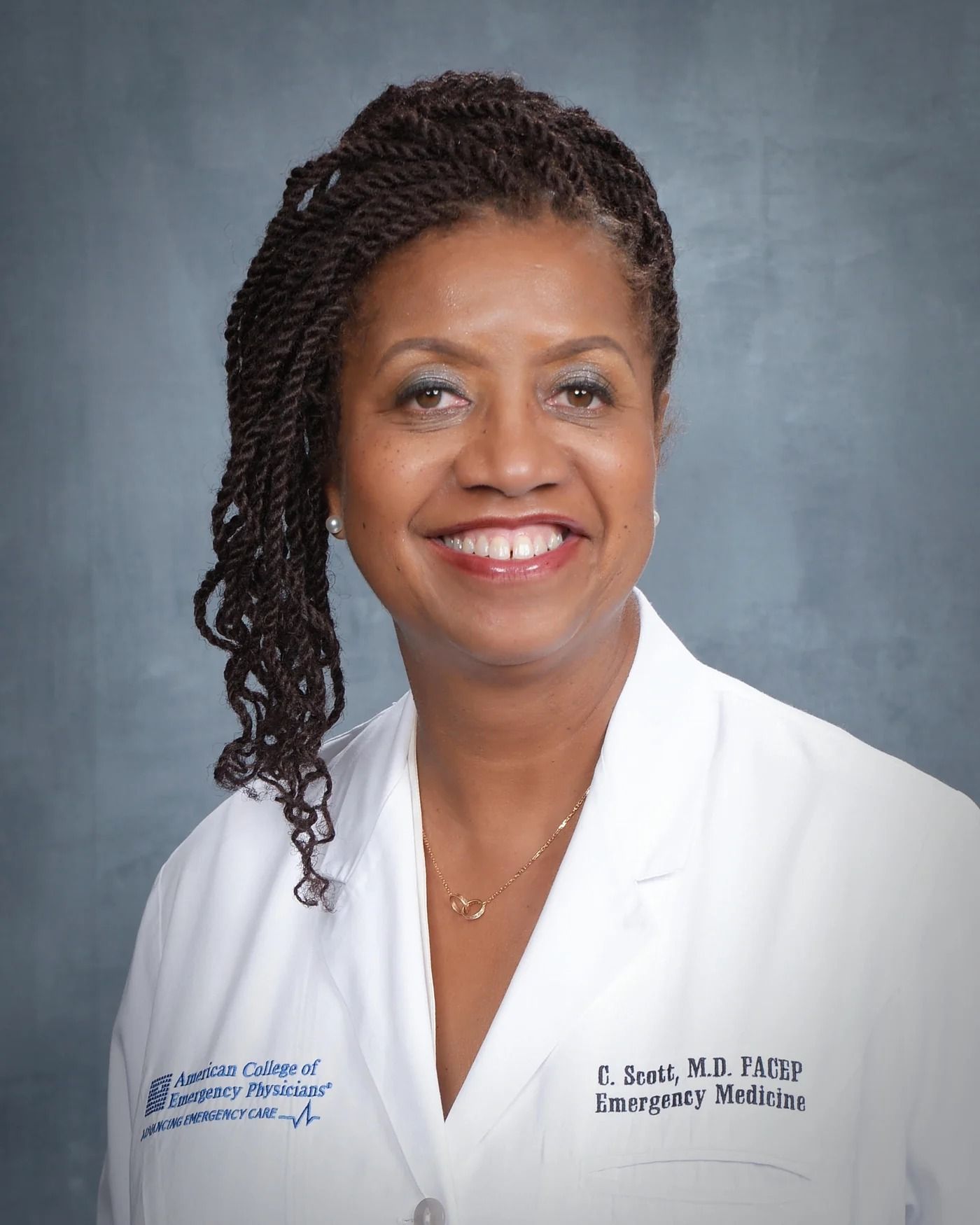
Dr. Carol J. Scott
Dr. Scott is a board-certified emergency physician who trained in internal medicine at Duke and in emergency medicine at Johns Hopkins, where she served as an Assistant Chief of Service. She is a Fellow of the American College of Emergency Physicians, a board-certified health and wellness coach and a board-certified patient advocate. Emergency medicine shows a doctor, over and over, the moment when small failures finally line up. The SCOTT Protocol is her attempt to move that moment earlier, to the kitchen table.
"By accepting your body, health and wellness as a business, your first action step is to become CEO of your wellness. Your doctor is your COO, who helps support you in achieving your goals. You can outperform your family's health legacy."
Field notes
Longer reads on what aviation, nuclear power and the emergency department can teach a patient.
- A clean bill of health is a snapshot Why a normal checkup can be the most reassuring and least informative hour of your year.
- The swollen ankle you stopped noticing A warning sign that doesn’t hurt you the first time is easy to stop seeing. The space shuttle program learned that at a terrible price.
- “Is he not clear, then?” The question asked thirteen seconds before the worst accident in aviation history, and what it teaches about speaking up in an exam room.
- Going home is a handoff In one study, nearly 1 in 5 patients sent home from the hospital had an adverse event within weeks. Here is how to run the handoff like a shift change.
Run your health like it matters, with a physician on your side.
Dr. Scott works with individuals, families and leadership teams through The Scott Health Advisory: a structured review of where your health could fail, and a plan to keep it from happening.
or call 410-336-7894