Field note on oversight
“Is he not clear, then?”
The question asked thirteen seconds before the worst accident in aviation history, and what it teaches about speaking up in an exam room.
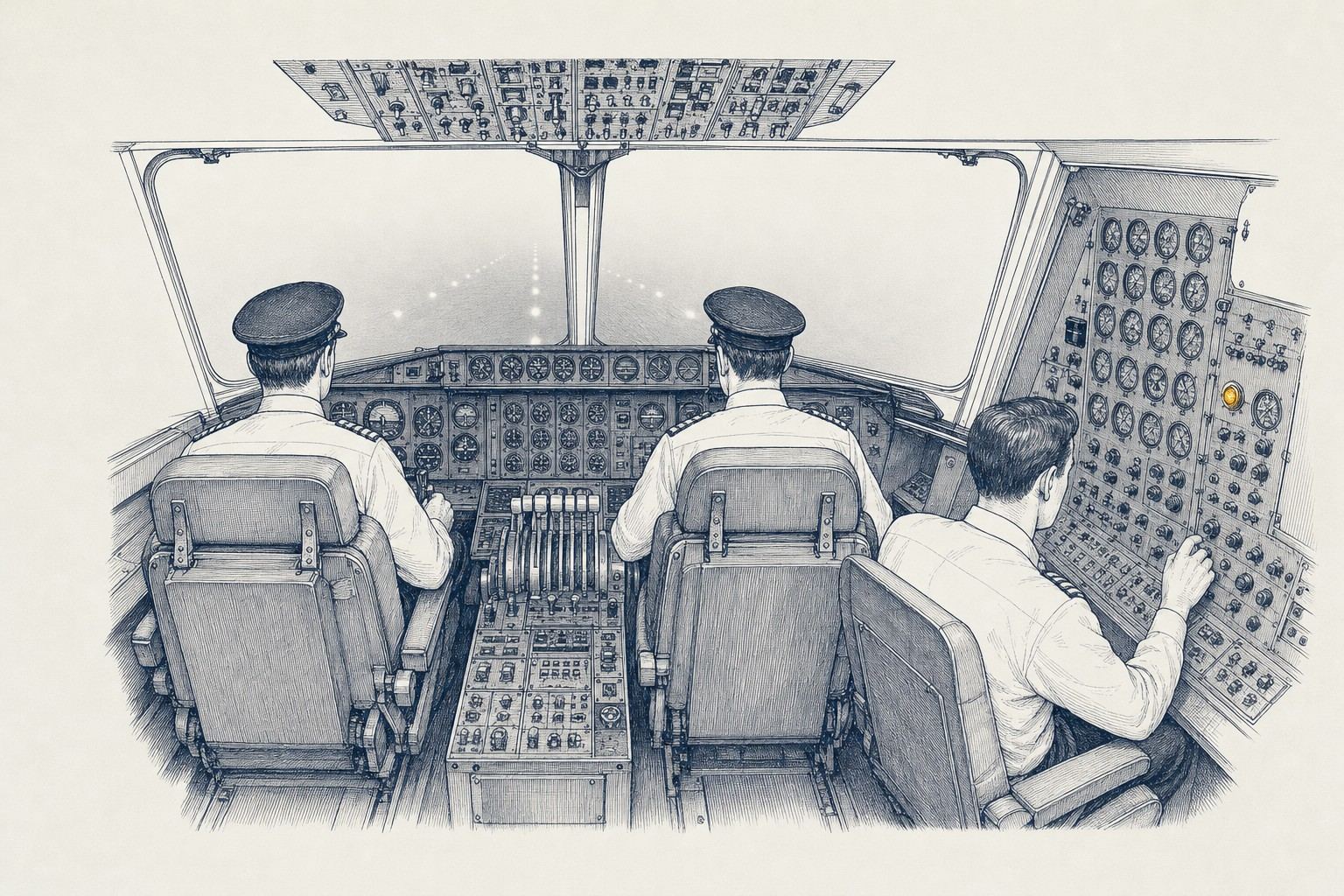
On the afternoon of March 27, 1977, two Boeing 747s were on the same runway at Los Rodeos Airport on Tenerife, in the Canary Islands, and the field was wrapped in fog. A Pan Am jet was taxiing down the runway, looking for its turn off. At the far end, a KLM jet had lined up for departure.
The KLM crew had three people on the flight deck: the captain, the first officer and the flight engineer. At
17:06:11 by the cockpit recorder, the brakes came off. Fourteen seconds later the tower asked the Pan Am crew to report
when they were clear of the runway, and they said they would. The KLM flight engineer had been listening. At
17:06:32 he asked, Is he not clear, then?
The captain said, What do you say?
The engineer tried again: Is he not clear, that Pan American?
The
captain answered, emphatically, Oh, yes.
According to NOVA’s annotated transcript, nobody on the KLM flight deck questioned the takeoff again. About thirteen seconds later the two aircraft collided, killing 583 people. It is still the deadliest accident in aviation history.
The last minute on the KLM flight deck
From the cockpit voice recorder transcript, Los Rodeos Airport, Tenerife, March 27, 1977. Local times. The gap at the bottom is drawn to scale.
- KLM first officer
Wait a minute, we don’t have an ATC clearance.
- KLM captain
No, I know that. Go ahead, ask.
- Tower
…[you are cleared] to the Papa beacon.
A clearance for the route after departure. It is not a clearance to take off. - KLM Brakes released.
- KLM captain
Let’s go … check thrust.
- Tower
Stand by for takeoff … I will call you.
In the same second, the Pan Am crew radios that it is still taxiing down the runway. - Tower to Pan Am
…report runway clear.
- KLM flight engineer
Is he not clear, then?
- KLM captain
What do you say?
- KLM flight engineer
Is he not clear, that Pan American?
- KLM captain
Oh, yes.
Spoken emphatically, according to the transcript. - About 12 seconds. No one on the KLM flight deck questions the takeoff again.
- Impact583 people die. It remains the deadliest accident in aviation history.
Transcript and timings: NOVA, "The Final Eight Minutes", drawn from the official Spanish accident report; death toll from NOVA's introduction. Brackets are NOVA's. An ellipsis at the start of a line marks a call sign trimmed for length.
The right worry, in the wrong form
The flight engineer was right. He had caught the one fact that mattered, that another airplane might still be on the runway, and he said so out loud, twice. It didn’t work, and the reason is worth sitting with: he said it as a question.
A question hands the decision to the person being asked. It invites a yes or a no, and the person with the most
authority in the room gets to supply it. Is he not clear?
can be closed with two words, and it was. A
statement such as Pan Am hasn’t reported clear; stop
puts the information on the table and asks for an
action. Nobody can say “oh, yes” to it.
It wasn’t the only challenge in that minute. At 17:05:41, before the brakes came off, the first officer had said,
Wait a minute, we don’t have an ATC clearance.
The crew radioed, and the tower answered with a route
clearance for after departure. It was not permission to take off, but it was enough to let the moment pass. Two members of the
crew raised a concern within a minute of each other. Both concerns were absorbed.
Portland, eighteen months later
On December 28, 1978, United Airlines Flight 173 was approaching Portland, Oregon, when a landing gear problem came up. The crew held near the airport for about an hour while they worked on it and prepared the cabin for a possible emergency landing. The DC-8 ran out of fuel and came down in a wooded suburban neighborhood about six nautical miles southeast of the field. Eight passengers, the flight engineer and a flight attendant were killed.
The National Transportation Safety Board’s report on the accident named as probable cause the captain’s failure to monitor the fuel and respond to “the crewmember’s advisories regarding fuel state.” Then it named a contributing cause that would change aviation: “the failure of the other two flight crewmembers either to fully comprehend the criticality of the fuel state or to successfully communicate their concern to the captain.”
In other words, people in the cockpit knew. The Board wrote that the other crew members’ inputs matter “because they provide redundancy,” and recommended that airline crews be trained in what it called flightdeck resource management, “with particular emphasis on the merits of participative management for captains and assertiveness training for other cockpit crewmembers.” The same month that recommendation was adopted, June 1979, NASA hosted an industry workshop in San Francisco titled “Resource Management on the Flight Deck.” Crew resource management, the training airlines built around these ideas, grew out of that work and out of the lessons of United 173 and other accidents.
Its central idea is simple to state and hard to practice. The junior person’s worry is part of the safety system, and the senior person’s job includes hearing it.
Every exam room has a captain
A medical visit has its own steep hierarchy, and the patient usually sits at the bottom of it. You are undressed,
or worried, or both. The clinician has the training, the vocabulary and the clock. Most people walk in already
reluctant to be “difficult,” and so a real worry comes out softened, as a question that is easy to answer kindly
and move past. Do you think it’s anything?
Is that pill the right one?
Should I be worried about
this?
The answer you get is often a reassuring yes or no, given in good faith by someone who doesn’t have the information you have. That last part is the important one. You know how you felt last month and what your readings did at home. At a hospital bedside, the family member knows what Dad’s pills usually look like and that Mom was sharper this morning. Like the flight engineer, you may be holding the one fact that matters.
“No physician is an expert in what it’s like to be you or how you define wellbeing.” Dr. Scott, from the original SCOTT Protocol
Dr. Carol J. Scott made this the core of oversight, the third step of her protocol. It adapts the high reliability principle of deference to expertise, in which decisions go to whoever knows the most about the problem, whatever their rank. In her words, “as an expert in you, you have the ability to bring relevant, timely information to your provider.” Bringing it isn’t enough, though. It has to arrive in a form that can’t be closed with two words.
Four moves for saying it plainly
Here is a sequence that turns a worry into a statement. Use the parts in order; each one makes the next harder to brush aside.
- State your concern. Begin with “I’m concerned” or “I’m worried,” and say what about.
- Say what you think might be happening. You don’t have to be right. A specific guess gives the clinician something to confirm or rule out.
- Ask a direct question. One that needs an action or an answer, not a reassurance.
- Ask what would change the plan. This sets a tripwire: you leave knowing exactly what should send you back.
Two examples, both hypothetical, show the difference.
Say your home blood pressure log runs higher than the readings at the office.
“My numbers at home are kind of high sometimes. Is that normal?”
“I’m concerned my blood pressure isn’t as controlled as the office readings say. Most mornings this month it’s been higher at home. Could my home readings be the more accurate ones? Will you look at the log, and what numbers would make you change my plan?”
Imagine a nurse is about to give your father a pill that doesn’t look like the one he’s taken for years.
“Is that his usual pill?”
“I’m worried about this pill. It doesn’t look like the one he takes at home. I think it could be a different drug or a different dose. Can you check it against his list before he takes it?”
Neither statement accuses anyone, and both leave room to be wrong. A good clinician will usually welcome them, because they arrive with the reason attached. If the pill is the right one, it takes a minute to confirm. If it isn’t, that minute is the whole point.
If the answer still doesn’t sit right, say so once more, plainly: “I’m still worried. I’d like this checked.” The flight engineer at Tenerife stopped after his second try. You don’t have to.
What this is, and what it isn’t
These four moves are adapted from aviation, from the lessons of accidents like Tenerife and United 173 and the NTSB’s call for “effective expression of concern.” They are a way of organizing what you say. Nobody has run a clinical trial of this exact script in an exam room, and it shouldn’t be read as a proven medical intervention. Its value is that it forces you to be clear about what you are worried about and what you want done, which is useful whatever the evidence turns out to say.
There is a tested tool for the other end of the visit. The Institute for Healthcare Improvement’s Ask Me 3 gives patients three questions to ask before they leave:
- What is my main problem?
- What do I need to do?
- Why is it important for me to do this?
Together the two cover the whole conversation: say what you know clearly on the way in, and make sure you understand what you’ve been told on the way out.
Bring a second voice
The 747 had three people on its flight deck for a reason. When the stakes are high, such as a new diagnosis, a procedure or a hospital stay, bring someone. A spouse, a sibling or a grown child can take notes, notice what you missed and, when it matters, be the one who says, “I’m concerned.” Agree beforehand that they have your permission to speak.
Put it to work
This note belongs to oversight, the third step of the SCOTT Protocol: put the right expert on the problem, and bring your own expertise too. Two field kit tools help you walk in prepared.
- Checklists for the moments that go wrong The checklist for before an appointment helps you write down your concern, your guess and your question in advance.
- Your one-page health brief Hand a clinician your history on one page, so the facts you know arrive with you. It stays in your browser.
Last updated October 16, 2026. Guidance cited here was current on that date; clinical guidelines change, so check with your own clinician. See our editorial policy.
More field notes
All field notes- A clean bill of health is a snapshot Why a normal checkup can be the most reassuring and least informative hour of your year.
- The swollen ankle you stopped noticing A warning sign that doesn’t hurt you the first time is easy to stop seeing. The space shuttle program learned that at a terrible price.
- Going home is a handoff In one study, nearly 1 in 5 patients sent home from the hospital had an adverse event within weeks. Here is how to run the handoff like a shift change.
Run your health like it matters, with a physician on your side.
Dr. Scott works with individuals, families and leadership teams through The Scott Health Advisory: a structured review of where your health could fail, and a plan to keep it from happening.
or call 410-336-7894