Field note on consistent monitoring
The swollen ankle you stopped noticing
A warning sign that doesn’t hurt you the first time is easy to stop seeing. The space shuttle program learned that at a terrible price.
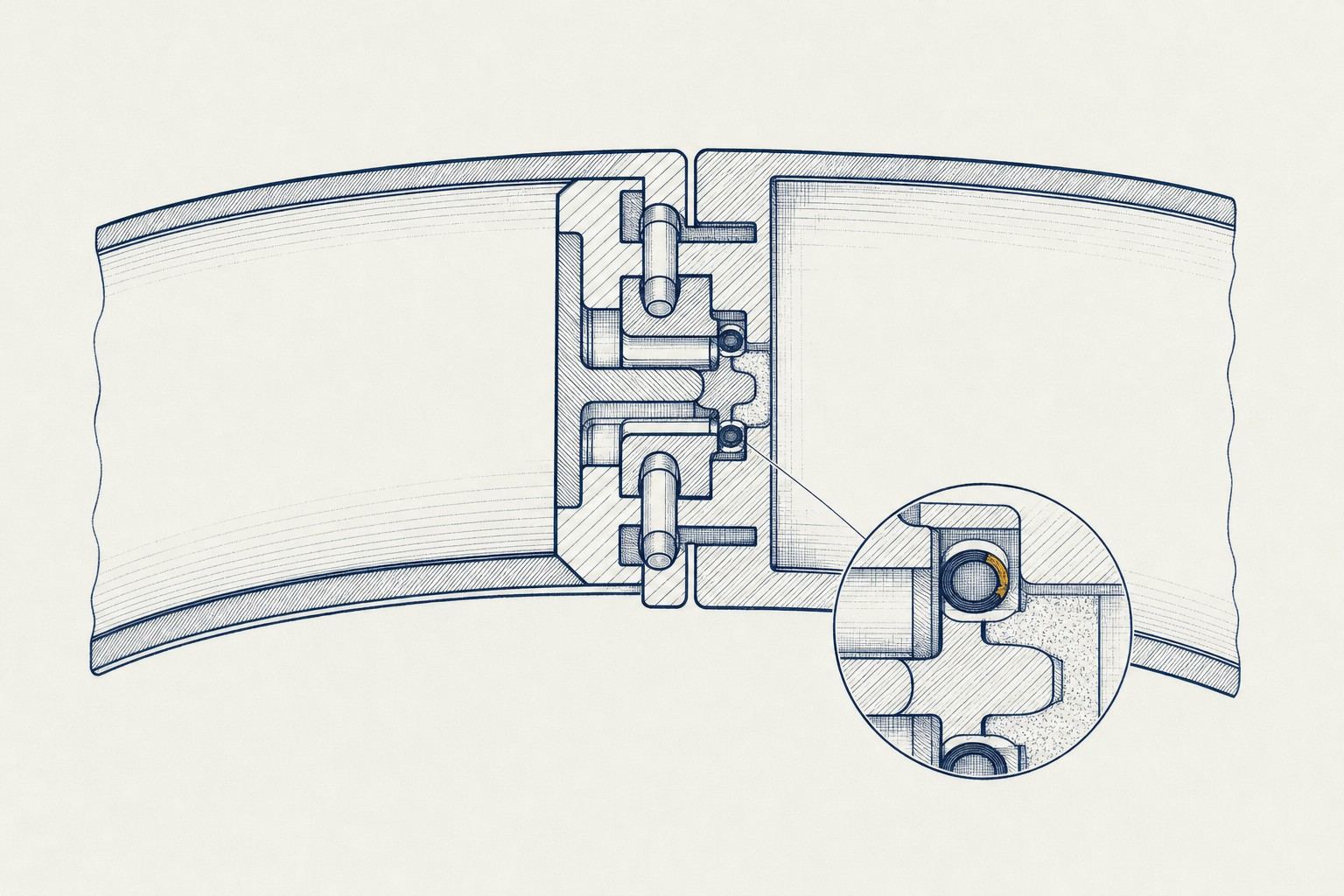
Imagine noticing, one evening, that your sock has left a deep ring around your ankle. The skin there looks a little full. It doesn’t hurt, and you’ve been on your feet all day, so you put them up and go to bed. By morning it’s mostly gone.
A week later it’s back. You notice again, less sharply. A month in, the evening puffiness is part of how your ankles look, the way a squeaky stair is part of how your house sounds. By the third month you have stopped looking. If a doctor asked whether your legs ever swell, you might honestly say no.
This note is about that last step: the process by which something you noticed turns into something you no longer see. The clearest account of it doesn’t come from medicine. It comes from the investigation of a space shuttle.
Flights that worked
On January 28, 1986, the space shuttle Challenger broke apart 73 seconds after liftoff and all seven people aboard were killed. The cause was a joint in one of the solid rocket boosters, where rubber O-rings were supposed to seal the gap between steel segments. Using data from earlier flights, engineers had advised against launching in temperatures below 53°F. At liftoff, it was 36°F.
What makes Challenger useful to the rest of us is that the joint had been showing damage for years. O-rings on earlier flights had come back eroded, and each time the shuttle had flown and landed safely anyway. The presidential commission that investigated the accident titled the relevant chapter of its report “An Accident Rooted in History”, and summarized that history in one sentence: NASA and contractor management “first failed to recognize it as a problem, then failed to fix it and finally treated it as an acceptable flight risk.”
The language along the way is worth reading slowly. The booster contractor, Morton Thiokol, described its position on the joint as “the condition is not desirable but is acceptable.” In July 1985, six months before the accident, a Thiokol engineer named Roger Boisjoly wrote in a memo that “the mistakenly accepted position on the joint problem was to fly without fear of failure.”
The physicist Richard Feynman, a member of the commission, wrote a separate appendix that is still one of the plainest things ever written about risk. He noticed that each successful flight had been counted as evidence that erosion was safe: “The acceptance and success of these flights is taken as evidence of safety.” He disagreed. The O-rings, he pointed out, were not designed to erode at all.
“Erosion was a clue that something was wrong. Erosion was not something from which safety can be inferred.” Richard Feynman, Appendix F of the Rogers Commission report, 1986
Then came the line people still quote: “When playing Russian roulette the fact that the first shot got off safely is little comfort for the next.”
No villain required
The easy version of this story has a villain. When the sociologist Diane Vaughan began studying the launch decision, it looked to her like “a typical case of misconduct.” What she found instead, and described in The Challenger Launch Decision (1996), was a long series of reasonable-looking decisions, each one made against the standard set by the decision before it. She called the pattern the normalization of deviance: a departure from what should happen, repeated without visible harm, gradually becomes the new definition of normal.
A recent profile in Columbia Magazine sums up her finding as deviations that become ingrained through a mix of production pressure, poor communication and workplace culture. Vaughan’s own phrasing gives the idea its reach: “mistakes themselves are socially organized and systematically produced.” The people involved were not careless. They were comparing each flight with the last one.
That comparison is the whole mechanism. Once last time becomes the yardstick, a slow change never looks like a change.
The same mechanism, in one body
You run your own small version of this every day, because a body generates far more signals than anyone could chase. Most aches pass. Most odd days are just odd days. Ignoring nearly all of it is sensible. The trouble starts with the few signals that don’t pass, because they follow the shuttle’s script almost exactly. A symptom appears. Nothing bad happens. You find an explanation that fits: a long day, a salty dinner, the heat, getting older. The explanation becomes the default, and each new appearance gets measured against the last one instead of against the way you used to be.
Dr. Carol J. Scott built a guard against this into the second step of her protocol, consistent monitoring, which borrows the high reliability principle known as reluctance to simplify. Her own example of the trap is a person explaining away a cluster of symptoms:
“My headache, thirst and blurred vision are just due to working hard and lack of sleep.” Dr. Scott’s example, from the original SCOTT Protocol
The explanation is tidy, and it may be wrong in an important way: unusual thirst and blurry vision both appear on the CDC’s list of diabetes symptoms. A simple story has quietly replaced a question.
How a warning sign moves the goalposts
Imagine a symptom that grows a little each week. Compare each week with the week before, the way memory does, and then with a baseline you wrote down at the start. An illustration with invented values, not patient data.
- Stands out
- Feels normal
- The line each week is judged against
Against last week, only week 1 stands out. Every later week is a small step from the one before, so nothing registers.
Show the numbers
| Week | How noticeable (invented scale) | Last week's normal | Stands out against last week? | Stands out against the baseline (1.6)? |
|---|---|---|---|---|
| Week 1 | 2.00 | 1.60 | Yes | Yes |
| Week 2 | 2.30 | 2.45 | No | Yes |
| Week 3 | 2.60 | 2.75 | No | Yes |
| Week 4 | 2.95 | 3.05 | No | Yes |
| Week 5 | 3.30 | 3.40 | No | Yes |
| Week 6 | 3.65 | 3.75 | No | Yes |
| Week 7 | 4.00 | 4.10 | No | Yes |
| Week 8 | 4.40 | 4.45 | No | Yes |
Illustration of the pattern Diane Vaughan named the normalization of deviance in The Challenger Launch Decision (1996). The values are invented to show the shape of the problem.
What a swollen ankle can mean
This is not a guide to diagnosing your own legs, and the ankle in this essay is a stand-in for any slow symptom. Still, swelling makes a good example precisely because it has so many possible causes. The National Library of Medicine’s MedlinePlus page on foot, leg and ankle swelling lists ordinary ones, such as long flights, standing for long periods, carrying extra weight and getting older, and some that are not ordinary at all, including a blood clot in the leg, an infection, veins that can’t return blood to the heart properly, and heart, kidney or liver failure. Several common medicines can cause it too, including some blood pressure drugs and anti-inflammatory painkillers.
The same page is clear about urgency. Call 911 if swelling comes with shortness of breath or chest pain, especially pressure or tightness. Contact a clinician right away if the swollen leg is red or warm, if you have a fever, if you have heart or kidney disease and the swelling gets worse, if you have liver disease and now have swelling in your legs or belly, if you’re pregnant and the swelling is more than mild or comes on suddenly, or if there is new or worsening swelling in only one leg. And contact a clinician if it simply doesn’t get better.
Notice what MedlinePlus says a clinician will ask about swelling: whether it’s there all the time or worse in the morning or evening, what makes it better or worse, whether raising your legs helps. Every one of those questions assumes you have been paying attention. A symptom you stopped seeing is a symptom you can’t describe.
Pain is a poor alarm
Part of what lets a symptom fade is that it doesn’t hurt. People reasonably use pain as their threshold for seriousness, and many serious conditions never cross it. The National Cancer Institute addresses this directly in its guidance on symptoms of cancer: “Often, cancer does not cause pain, so do not wait to feel pain before seeing a doctor.” Its rule of thumb is simple enough to remember: “If you have symptoms that do not get better after a few weeks, see your doctor so that problems can be diagnosed and treated as early as possible.”
A few weeks is a useful clock because it is short enough to beat normalization. By the time a change has been with you for three months, you have explained it to yourself dozens of times.
How to keep a symptom from becoming furniture
High reliability organizations don’t rely on people noticing. They build the noticing into the routine so it doesn’t depend on anyone’s mood that day. You can borrow the idea with very little equipment.
Write it down the first time
The first time is when you see it clearly. A dated note on your phone (“puffy left ankle, evening, sock mark”) is a fixed baseline. Memory drifts; a date doesn’t. If the symptom is visible, a photo taken in the same light each week does the same job.
Compare with the first note, not with last week
This is the whole lesson of the chart above. Last week’s version of a symptom is the worst possible reference, because it has already been normalized. The first note is the one that hasn’t.
Set a review date
Decide in advance when “wait and see” ends. The NCI’s few weeks is a sensible default for anything new that hasn’t gone away. Put the date in your calendar the day you write the note, while you still take it seriously.
Tell the history, not the latest
At the appointment, “my ankle’s a bit puffy” invites reassurance. “My left ankle has swelled most evenings for six weeks, and it’s getting higher on my leg” describes a trend, and trends get worked up. If you have the dated notes, bring them.
Let someone else look
The people who live with you haven’t been normalizing your symptom from the inside. A spouse, a sibling or an adult child who says “that looks different” is giving you an outside reading. Take it seriously, even when it’s annoying.
Nature cannot be fooled
Feynman ended his appendix with a sentence that applies well beyond rockets: “For a successful technology, reality must take precedence over public relations, for nature cannot be fooled.” Everyone runs a little public relations operation for their own body. It issues statements like “just tired” and “probably the heat,” and most of the time the statements are true.
The habit worth building is to notice when one of those statements has been running for a month. That’s the moment to stop explaining and start asking.
Put it to work
This note belongs to consistent monitoring, the second step of the SCOTT Protocol. The field kit has two tools that help you catch a drifting symptom early and describe it well.
It leans on self-awareness too: know where you could fail before your body tells you.
- Checklists for the moments that go wrong Start with the one for before an appointment, so a slow symptom gets said out loud with its dates attached.
- Your one-page health brief Keep your baselines and current concerns on one printable page. It stays in your browser.
Last updated October 16, 2026. Guidance cited here was current on that date; clinical guidelines change, so check with your own clinician. See our editorial policy.
More field notes
All field notes- A clean bill of health is a snapshot Why a normal checkup can be the most reassuring and least informative hour of your year.
- “Is he not clear, then?” The question asked thirteen seconds before the worst accident in aviation history, and what it teaches about speaking up in an exam room.
- Going home is a handoff In one study, nearly 1 in 5 patients sent home from the hospital had an adverse event within weeks. Here is how to run the handoff like a shift change.
Run your health like it matters, with a physician on your side.
Dr. Scott works with individuals, families and leadership teams through The Scott Health Advisory: a structured review of where your health could fail, and a plan to keep it from happening.
or call 410-336-7894